
WHAT IS SUSTAINABILITY?
Sustainability represents a social goal related to people’s ability to coexist safely on Earth over the long term. Sustainability is defined in three contexts: environmental, economic, and social. Today, sustainability is more present on our agenda than ever before. People are trying to act more carefully by considering how every step they take will affect the planet we live on.
Countries and institutions are not remaining indifferent to this issue and are trying to find solutions to problems through various action plans. One of the most important of these is the 2030 Agenda for Sustainable Development, adopted by the United Nations Member States in 2015. The Agenda sets out 17 Sustainable Development Goals, including the eradication of poverty and hunger, the improvement of education, water quality, and the protection of natural resources such as oceans and forests.
Libraries play a strong role in achieving these 17 goals. According to the International Federation of Library Associations and Institutions (IFLA), libraries have both a global reach and an inherent understanding of local priorities.
AREAS TO WHICH LIBRARIES CONTRIBUTE
Librarians hold a strong position in their communities as repositories of knowledge and experience. By promoting sustainable practices and concepts, libraries can inspire others to adopt new behaviors.
IFLA’s Environment, Sustainability and Libraries Section recognizes libraries for their sustainability efforts through the IFLA Green Library Award.
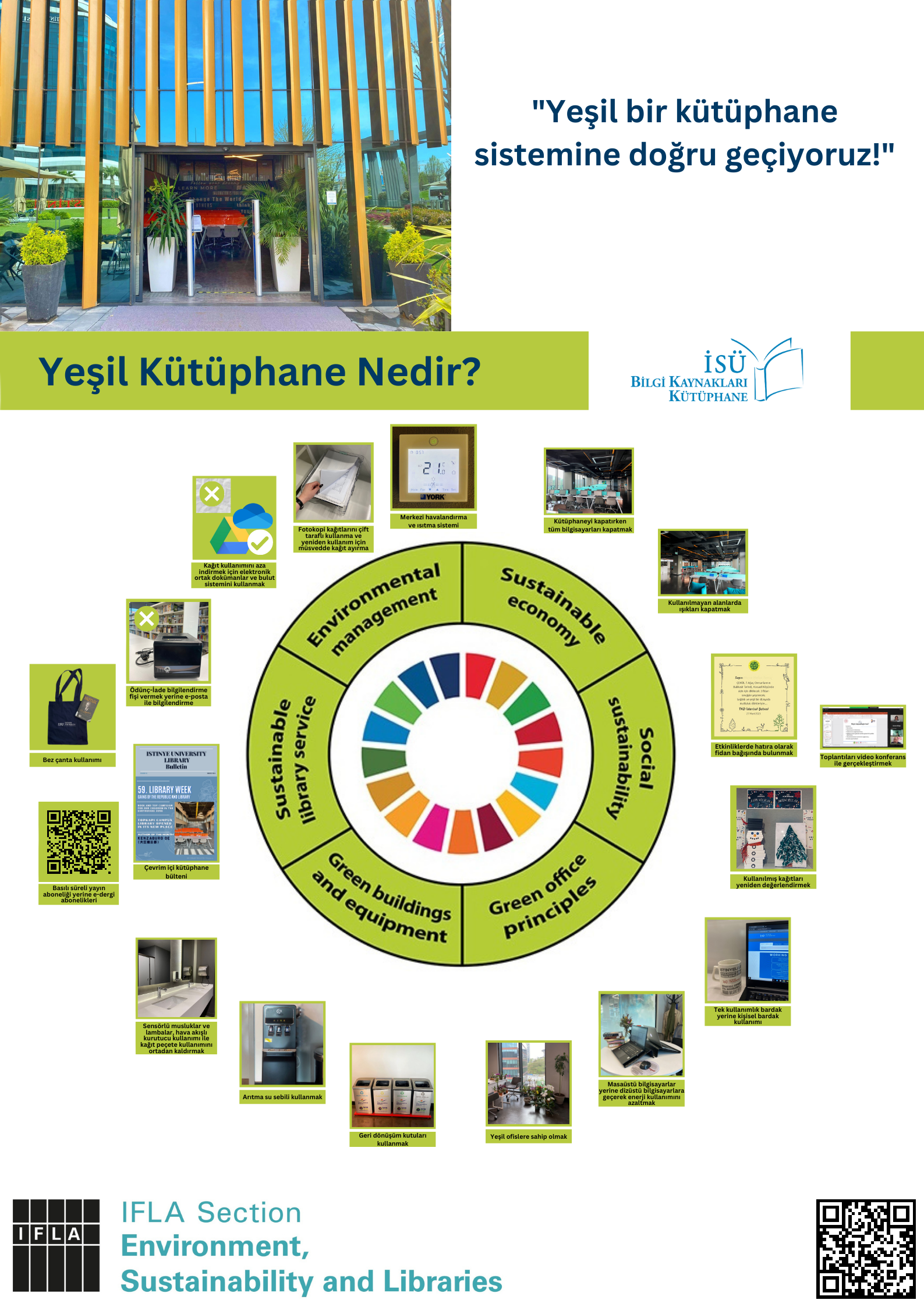
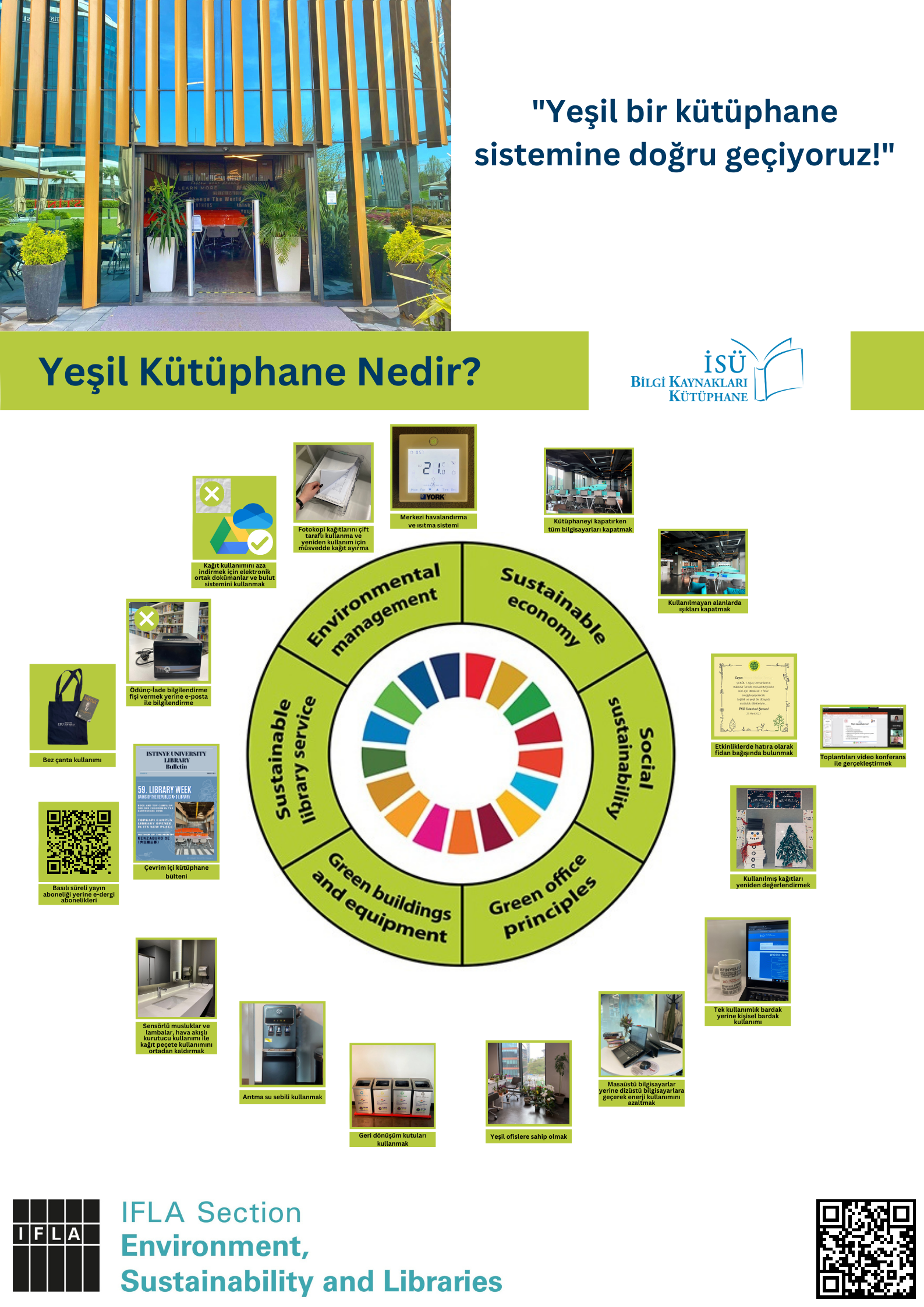
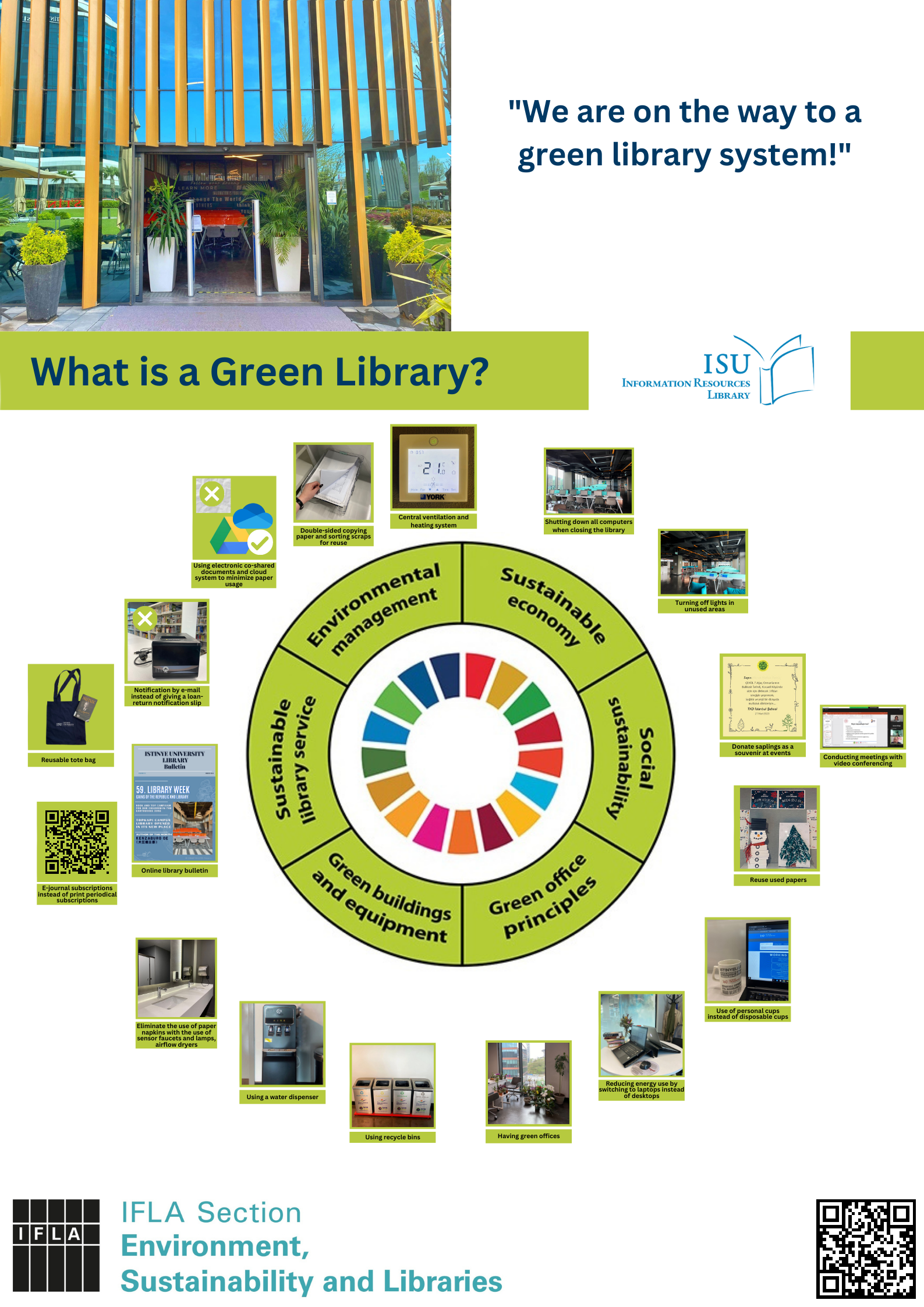
In order to contribute to sustainability-related work carried out under the umbrella of IFLA, our posters prepared in Turkish and English were accepted and published on IFLA’s “Environment, Sustainability and Libraries - Green Library Poster” page. We became the first library from Türkiye to participate in this initiative. You can review our poster works and the related webpage through the links below.
Today, libraries have begun to adopt environmentally friendly practices in their design, construction, and renovation processes. When replacing old library buildings with new, energy efficient ones, libraries reduce their carbon footprint and lower utility costs such as electricity bills by implementing sustainable measures such as LED lights with motion sensors, wall and ceiling insulation, energy efficient windows, and solar panels.
Libraries also have the opportunity to evaluate and transform their programs to reflect progress toward sustainability. Among the notable ongoing efforts are libraries that are expanding the range of materials available for users to borrow. For example, in some library systems, users can borrow toys, seeds, musical instruments, and even new technologies.
ACADEMIC LIBRARIES and SUSTAINABILITY
ACADEMIC LIBRARIES
While libraries play an important and unique role in raising awareness about resilience to climate change and a sustainable future, they also support further academic research and accelerate progress toward solutions to these issues by providing researchers with the latest resources on these topics.
Academic libraries take part in efforts to reduce the library’s carbon footprint while also contributing effectively to sustainability by supporting access to research related to the Sustainable Development Goals (SDGs) and by carrying out joint initiatives with different institutions.
SUPPORTING SUSTAINABILITY RESEARCH
Libraries play an important role in efforts to develop solutions to global issues such as climate change, energy resources, and economic equality. By providing the necessary printed and electronic resources for scholars, libraries enable research to be conducted and solutions to be developed.
The increase in open access publications on topics such as climate change, equality, peace, and justice, and the communication of these publications to stakeholders through the library, will facilitate the work of researchers studying these issues, and the freely accessible data they obtain will have a high impact on research outputs.
At this stage, librarians should closely follow the literature on topics such as climate change, environment, and economics in order to support their users’ work, and should take the necessary initiatives to add these resources to the collection. They should also make plans for the effective use of the enriched collection. Training sessions should be organized to promote these resources and support their use.
Thanks to the resources it holds, the library can serve as a guide for researchers regarding what kinds of studies are being conducted in which fields and with whom from different sectors they might collaborate for these studies. For this purpose, it can prepare and announce resources such as lists of influential publications, lists of popular research topics, and sample lists of interdisciplinary collaborations for its researchers, and it can organize training sessions.
GREEN COLLECTION
You can access the printed materials on sustainability available in the ISU Library collection here.
Depending on your research needs, you can access the ISU Library databases and e-book collections here.
For books, articles, book chapters, and theses not available in the ISU Library collection, borrowing services are provided from the libraries with which we have agreements through the Interlibrary Loan and Document Delivery Service (ILL). For your requests for books, articles, book chapters, and theses, you can fill out the “ILL Request Form” on the Library website and send it to us.
To access the top 40 highly cited journals in Web of Science (WoS) on sustainability, please click here.
For more information about the United Nations Sustainable Development Goals, click here.
To access the checklist for sustainable structures (buildings), equipment, and management, click here.
You can access the latest publication of the Sustainable Development Solutions Network on how university campuses can be made greener here.
Top Action Tips for Academic Librarians
To access the list of Top Action Tips for Academic Librarians created by The SDG Publishers Compact Fellows, who are united in making sustainability and the Sustainable Development Goals central to science and learning, click here.
ISTINYE UNIVERSITY LIBRARY and SUSTAINABILITY
As Istinye University Library, with the goal of leaving a smaller carbon footprint, we are working to carry out activities that support the sustainability movement in the communities we engage with (within the university, non governmental organizations, the district and city we are located in, etc.) in order to raise awareness. While the connections we build help us reach more people and institutions, we also gain opportunities to serve as an example and a pioneer for society in this field.