FAKE NEWS
İstinye University Library has prepared a guide to help you understand the impact of fake news around the world and to support you in dealing with fake news by contributing to your knowledge of current solutions. First of all, in order to become a good consumer and producer of information, it is necessary to develop our critical thinking skills. You can use this guide to help develop these skills.
The guide provides tips and fact-checking resources to help you distinguish whether the news and other information you see, read, and hear are real or fake. Through this guide, you can become information literate and media literate, and critically evaluate information, for example, by distinguishing fake news from real news. You can also become aware of the ethical and unethical uses of information, including plagiarism.
Ask a Librarian!
Librarians are, by nature, verifiers through training. You can consult İSÜ librarians to help you distinguish what is real and what is fake. We are always here for you: kutuphane@istinye.edu.tr.
What Is Fake News?
In the past, information was more strictly controlled by media professionals, journalists, and librarians, but the open and ubiquitous nature of the digital world has made it more difficult for these traditional gatekeepers to control and verify information. However, the spread of misinformation and disinformation can have potentially destructive and dangerous consequences for political and social spheres (De Paor, Heravi, 2020, p. 1). We believe that the information we share on what fake news is and how it can be identified will be helpful to you.
Fake news is news that is printed or published while being known to be untrue. In UNESCO’s publication “Journalism, ‘Fake News’ and Disinformation: Handbook for Journalism Education and Training”, the definitions of fake news, misinformation, disinformation, and malinformation are as follows:
Fake news refers to false and misleading information that is presented in the form of news and circulated as though it were news. This includes satire, parody, clickbait, misleading headlines, images and statistics, authentic content shared out of context, imposter content, in which a journalist’s name or a media institution’s logo is used by people who have no connection with that person or institution, as well as manipulated or fabricated content. Discussions of “fake news” often combine the concepts of misinformation and disinformation. However, it may be helpful to distinguish misinformation as information that is false, but the person sharing it believes it to be true. Disinformation is also false information, but the person sharing it is aware that it is false. In other words, there is a deliberate lie involved here, and it points especially to people who have been repeatedly exposed to false information by malicious actors. The third category is malinformation, which can be defined as information based on reality but used to harm a person, institution, or country (UNESCO, 2022).
Why Is Fake News Created?
The main reasons underlying the creation of fake news are:
The intention to harm an institution, organization, or person. For example, fake news can bankrupt a company.
Financial gain. Clicks on a news item can generate money for the creator of fake news.
Political gain. Fake news can influence voters (Hunt, 2016).
What Are the Consequences of Fake News?
The rapid spread of fake news and online disinformation can have very significant consequences. These can negatively affect both individuals and society. Fake news may lead to the following outcomes:
Distrust in the media
Negative impact on the democratic process
The emergence of harmful conspiracy theories and hate speech platforms
The spread of false or unscientific views
How Can Fake News Harm You?*
Many People Believe Fake News Articles
Situations in which it is difficult to distinguish fake news from real news can cause confusion and misunderstandings about important social and political issues.
Fake News Can Affect Your Grades
İstinye University academics require the use of quality information sources for your research assignments and papers. Using sources that contain false or misleading information may negatively affect your grades. For reliable research in the İSÜ Library Collection, click here.
Fake News Can Be Harmful to Your Health
There is a great deal of fake and misleading news circulating about medical treatments and serious illnesses such as cancer or diabetes. Trusting these false stories may cause you to make decisions that could be harmful to your health.
Fake News Makes It Harder for People to See the Truth
It is stated that people have different views of the definition of fake news depending on their education and political beliefs. Consumers of fake news are driven to abandon certain outlets, consume less information in general, and even cut off social relationships. For this reason, it is important for people to seek out news that is as unbiased as possible.
Fake News and Reality Checking
Evaluating Sources
Evaluating sources is a very practical skill in both your academic and personal life. With practice, you can learn to critically evaluate every source and website you encounter quickly and efficiently. There are many different methods that can be used to help evaluate information. Librarians and libraries carry out important work in combating fake news, and librarians have assumed an important role in literacy education.
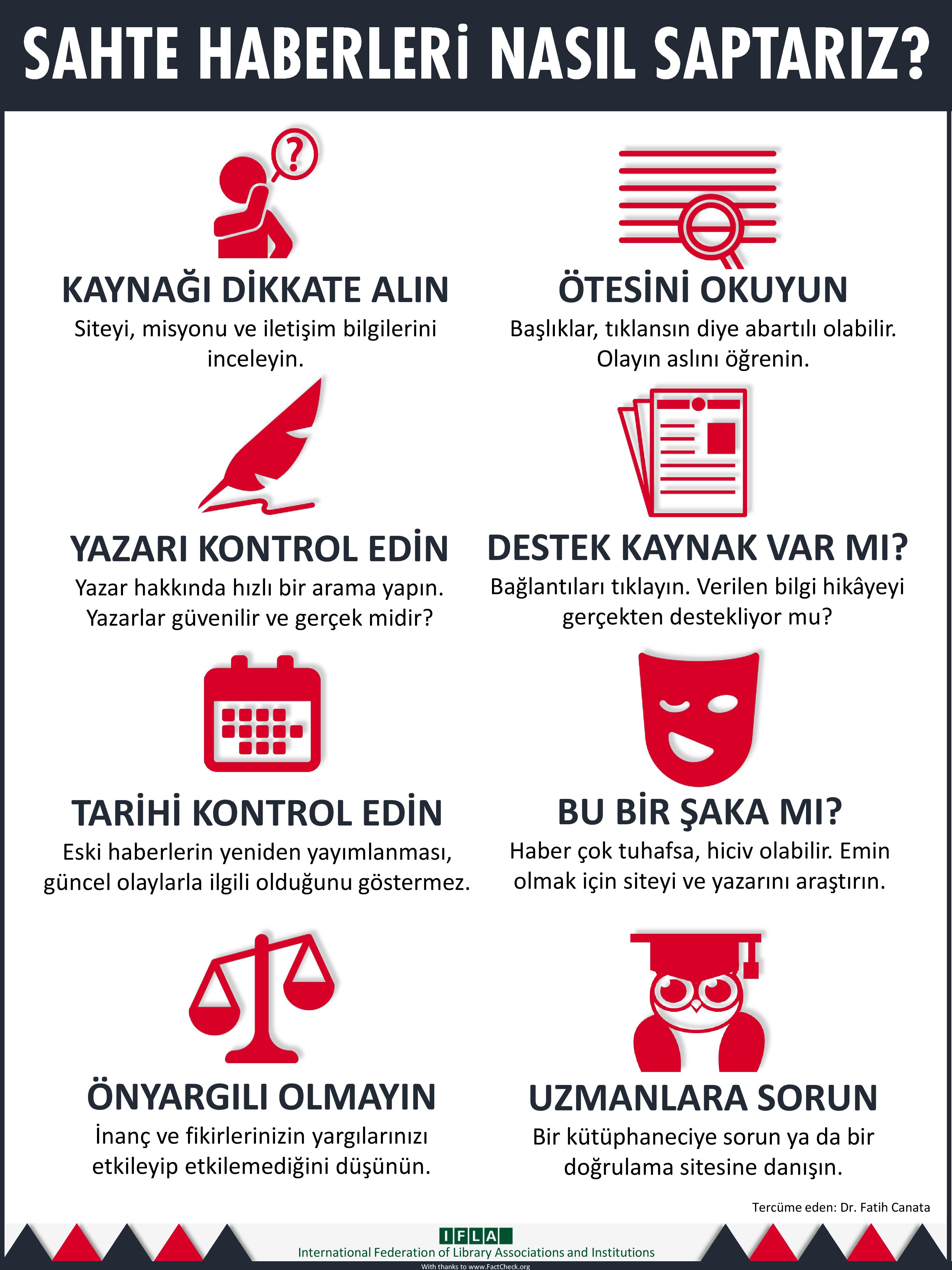
The International Federation of Library Associations and Institutions (IFLA) published an infographic describing the roadmap for combating fake news. This infographic explains how we can identify fake news.

Fake News Glossary**
Confirmation bias (verification bias, approval bias): The tendency to believe that information is credible if it fits the reader’s or viewer’s existing belief system, and not credible if it does not.
Container collapse: A situation in which we have difficulty distinguishing the original information container, format, or type of information, such as a blog, book, brochure, government document, chapter, journal, newspaper, magazine, or a section of a newspaper or magazine, when publishing cues disappear and every source appears as a digital page or printout.
Content farm or content mill: A company that employs a staff of freelance writers to create content designed to satisfy search engine accessibility algorithms in order to generate views and advertising revenue.
Echo chamber (echo room, echo bubble, echo cave, echo circle): The concept of an “echo chamber” is essentially used for environments in which a person encounters only views similar to their own or a single type of view and does not hear different voices (Terzi, 2022).
Fact-checking: The verification of claims either before publication or after the dissemination of content.
Filter bubble: When search tools present stories that we are likely to click on or share based on our past activities, potentially reinforcing our biases, we may be experiencing what Eli Pariser calls a filter bubble.
Herd phenomenon: The herd phenomenon can be defined as individuals deciding to follow others and imitate group behavior instead of making decisions independently and atomistically based on their own private information (Baddeley, 2010).
Native advertising: Paid, sponsored content designed to look like legitimate content produced by a media organization.
Satisficing: A word coined by Herbert Simon in 1956 by combining satisfy and suffice to refer to the tendency of people under time constraints to choose information that is good enough rather than the best possible information.
Triangulation or cross-verification: Researchers analyze and validate multiple perspectives and sources using various research methods, based on the idea that different perspectives can shed more light on a topic.
Virality: According to the Turkish Language Association Dictionary, viral refers to written, visual, or audio content that gains impact by spreading rapidly and uncontrollably among social media users after being shared online. When we pass along sensational stories, usually from social media, without checking their credibility in other sources, we increase their virality.
How Is Fact-Checking Done?***
What are the four steps and habits we should adopt in fact-checking to protect ourselves from fake news? Of course, you may not need to complete all four steps; fact-checking can also be accomplished in just a few steps.
Check previous work first: Do research to see whether someone else has already checked the claim or claims in question or obtained a research result.
Go upstream to the source: Most web content is not original. Reach the original source to understand the reliability of the information.
Read laterally: Once you reach the source of a claim, read what other people say about that source, such as the publication or author.
Go back: If you get lost, hit a dead end, or find yourself in an increasingly confusing environment, return to the beginning and start again with what you know. With different search terms and better decisions, you will probably follow a more informed path.
An important habit to add to the four steps: Check your emotions. Behind the art of arguing a point, there is a great deal of psychology, including efforts to provoke you. This increases the likelihood that you will immediately accept or reject a fact-based claim.
How Can I Tell What Is Real?
I. Be an Informed Media Consumer
Is the headline extreme and attention-grabbing? Is it ALL IN CAPS or in bold type? Does it use too many exclamation marks?!?!?!
Is it satire, a joke, or from a site imitating clickbait websites?
Consider the source, and be sure to search separately for the website or author. Are they reliable?
Are there links to supporting sources in the article?
When was the story written? Sometimes the news is real, but no longer current.
II. Examine Your Own Beliefs
Our biases sometimes affect the way we view events. What are your answers to the following questions?
Do your ideas or judgments cloud your ability to distinguish fake news from real news?
Do you read a variety of news sources, including those you do not always agree with?
III. Ask the Experts
Use fact-checking websites. Be careful not to use information whose accuracy has not been confirmed. Most importantly, consult your librarian.
In addition, for more information on this subject, you can access Mike Caulfield’s textbook “WEB LITERACY FOR STUDENT FACT CHECKERS” through the library’s open access resources.
You can use the SIFT method, which is used by many fact-checkers to determine whether a news source or claim is real and reliable.

The CRAAP Test is an evaluation method designed by librarian Sarah Blakeslee at the Meriam Library of California State University, Chico. CRAAP stands for “Currency,” “Relevance,” “Authority,” “Accuracy,” and “Purpose.” This method provides you with a set of questions and a framework for evaluating the quality and value of the information you find.
*The section “How Can Fake News Harm You?” was adapted from the Austin Community College Library Research Guide.
**The glossary section was adapted from USF Blogs.
***The fact-checking section was adapted from the Gustavus Adolphus College Library.
Books on “Media Literacy” and “Information Literacy” Available in the İSÜ Library Collection
```html id="qk4m28"


```
```html id="t9pn41"


```